P82 · Packing and covering · Classic · Hard

Equal circles in regular polygons · m = 5 · n = 14

Pack n equal circles into the regular m-gon with centre (1,1), circumradius 1, and first vertex (2,1) so as to maximise their common radius.

Instancem = 5 · n = 14
ObjectiveMaximize circle radius

Record comparison

circle radius · Higher is better
RecordValue / intervalAuthor / holderSource
External best known[0.202386816022, 0.202386816024]Eckard SpechtPackomania ↗
Site recordNo player record yet——

Formal definition

  • ContainerThe editor and certificate normalise the container to the exact regular m-gon with centre (1,1), circumradius 1, and first vertex (2,1), while public scores follow the literature convention. Boundary contact is allowed.
  • SubmissionSubmit {radius, placements:[{x,y,turn},…]}, with each value written as a decimal string of at most nine places. Here x, y are centre coordinates; circles require turn = 0 and polygons use turn = tan(θ/2). Coordinates and turn must lie in [−4, 4], with 0 < radius ≤ 4.
  • ConstraintsExactly n congruent pieces lie wholly inside the container with pairwise disjoint interiors. Polygons may rotate independently by arbitrary angles.
  • PrecisionInput decimals are parsed as exact rationals and regular-polygon vertices are defined algebraically, with zero floating-point tolerance in feasibility checks.
  • ObjectiveMaximise the circle radius r (with container circumradius fixed at 1).
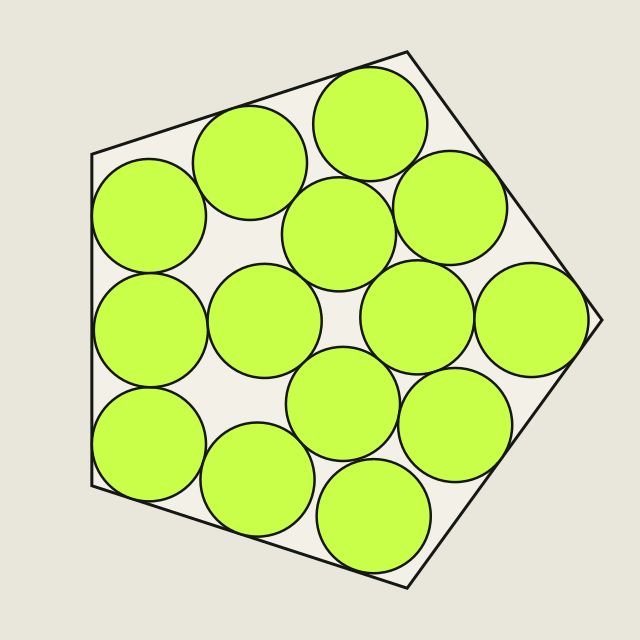
Open full editor ↗

Layout shown: starter layout

VERIFIED CONSTRUCTIONVERIFIED CONSTRUCTION

Getting a feel for it

Literature targets and coordinate certificates

Literature targets are converted at their published precision, while nine-decimal coordinate certificates are stored and displayed alongside the source values. Pentagon and hexagon rows n = 41–100 and octagon rows n = 41–48 cite Packomania's value and author without importing its coordinates; they start from an ordinary site grid baseline.

Source
The current arrangement for Equal circles in regular polygons m = 5 · n = 14
LAYOUT & HISTORY

Starter layout

Inspect the layout, solver notes and record history.

Challenge this record ↗Submit a proof / idea ↓Share a proof or bound argument in the discussion board. Accepted contributions earn proof points.
ANSWER FORMAT

How to write your answer

the regular m-gon with centre (1,1), circumradius 1, and first vertex (2,1)

Submit {radius, placements:[{x,y,turn},…]}, with each value written as a decimal string of at most nine places. Here x, y are centre coordinates; circles require turn = 0 and polygons use turn = tan(θ/2). Coordinates and turn must lie in [−4, 4], with 0 < radius ≤ 4.

Starter answer

{
  "placements": [
    {
      "turn": "0",
      "x": "0.393369822",
      "y": "1.368689755"
    },
    {
      "turn": "0",
      "x": "0.393369822",
      "y": "0.559257377"
    },
    {
      "turn": "0",
      "x": "0.400188857",
      "y": "0.963973566"
    },
    {
      "turn": "0",
      "x": "0.751599811",
      "y": "1.557138603"
    },
    {
      "turn": "0",
      "x": "0.778332422",
      "y": "0.434175445"
    },
    {
      "turn": "0",
      "x": "0.803630248",
      "y": "0.996787232"
    },
    {
      "turn": "0",
      "x": "1.067343792",
      "y": "1.303865170"
    },
    {
      "turn": "0",
      "x": "1.081460410",
      "y": "0.702419954"
    },
    {
      "turn": "0",
      "x": "1.178156366",
      "y": "1.694633454"
    },
    {
      "turn": "0",
      "x": "1.190418134",
      "y": "0.304397702"
    },
    {
      "turn": "0",
      "x": "1.345173954",
      "y": "1.009497892"
    },
    {
      "turn": "0",
      "x": "1.461188414",
      "y": "1.397289509"
    },
    {
      "turn": "0",
      "x": "1.479254477",
      "y": "0.627576295"
    },
    {
      "turn": "0",
      "x": "1.749836138",
      "y": "1.000000000"
    }
  ],
  "radius": "0.202386815"
}
Submission format and technical detailsOpen this when you are ready to prepare a JSON answer+

Instance parameters

{
  "n": 14,
  "sides": 5
}

Starter answer

{
  "placements": [
    {
      "turn": "0",
      "x": "0.393369822",
      "y": "1.368689755"
    },
    {
      "turn": "0",
      "x": "0.393369822",
      "y": "0.559257377"
    },
    {
      "turn": "0",
      "x": "0.400188857",
      "y": "0.963973566"
    },
    {
      "turn": "0",
      "x": "0.751599811",
      "y": "1.557138603"
    },
    {
      "turn": "0",
      "x": "0.778332422",
      "y": "0.434175445"
    },
    {
      "turn": "0",
      "x": "0.803630248",
      "y": "0.996787232"
    },
    {
      "turn": "0",
      "x": "1.067343792",
      "y": "1.303865170"
    },
    {
      "turn": "0",
      "x": "1.081460410",
      "y": "0.702419954"
    },
    {
      "turn": "0",
      "x": "1.178156366",
      "y": "1.694633454"
    },
    {
      "turn": "0",
      "x": "1.190418134",
      "y": "0.304397702"
    },
    {
      "turn": "0",
      "x": "1.345173954",
      "y": "1.009497892"
    },
    {
      "turn": "0",
      "x": "1.461188414",
      "y": "1.397289509"
    },
    {
      "turn": "0",
      "x": "1.479254477",
      "y": "0.627576295"
    },
    {
      "turn": "0",
      "x": "1.749836138",
      "y": "1.000000000"
    }
  ],
  "radius": "0.202386815"
}

Submit {radius, placements:[{x,y,turn},…]}, with each value written as a decimal string of at most nine places. Here x, y are centre coordinates; circles require turn = 0 and polygons use turn = tan(θ/2). Coordinates and turn must lie in [−4, 4], with 0 < radius ≤ 4. · Verifier v1.0.0

DISCUSSION

Discussion

Discuss strategies, share construction methods, or ask questions. Any signed-in user can post under their public byline and unique #UID. New posts appear after moderation.