P84 · Packing and covering · Classic · Hard

Equilateral triangles in a disc · n = 15

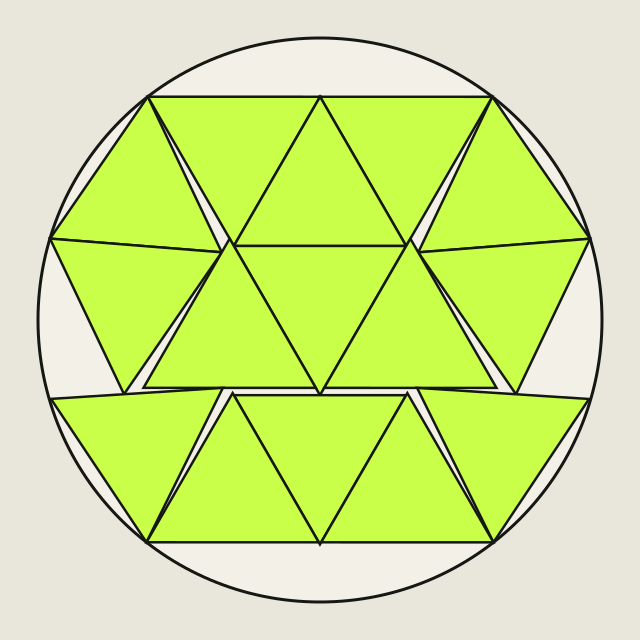
Pack n unit-side equilateral triangles into a disc. Contact is allowed; interiors cannot overlap. Minimise the container circle radius.

Instancen = 15
ObjectiveMinimize container circle radius

Record comparison

container circle radius · Lower is better
RecordValue / intervalAuthor / holderSource
External best known[1.636, 1.637)David W. CantrellErich Friedman ↗
Site record1.636720714NUE_13Record details ↓

Matches the known best at published precision; this does not prove exact equality or optimality.

Formal definition

  • ContainerThe editor and certificate normalise the container to the closed unit disc centred at (1,1), while public scores are reported in the literature's unit-piece scale. Boundary contact is allowed.
  • SubmissionSubmit {radius, placements:[{x,y,turn},…]}, with each value written as a decimal string of at most nine places. Here x, y are centre coordinates; circles require turn = 0 and polygons use turn = tan(θ/2). Coordinates and turn must lie in [−4, 4], with 0 < radius ≤ 4.
  • ConstraintsExactly n congruent pieces lie wholly inside the container with pairwise disjoint interiors. Polygons may rotate independently by arbitrary angles.
  • PrecisionInput decimals are parsed as exact rationals and regular-polygon vertices are defined algebraically, with zero floating-point tolerance in feasibility checks.
  • ObjectiveContainer circle radius = 1/(2 sin(π/3) r), where smaller is better. Pages, leaderboards, and literature records share this unit with automatic conversion.
Open full editor ↗

Layout shown: site record

VERIFIED CONSTRUCTIONVERIFIED CONSTRUCTION

Getting a feel for it

Literature targets and coordinate certificates

Literature targets are converted at their published precision, while nine-decimal coordinate certificates are stored and displayed alongside the source values.

Source
The record-holding arrangement for Equilateral triangles in a disc n = 15, 1.636720714
LAYOUT & HISTORY

Record details

Inspect the layout, solver notes and record history.

Record holderNUE_13
Solution methodAI · DeepSeek: DeepSeek V4.1 Flash
Challenge this record ↗Submit a proof / idea ↓Share a proof or bound argument in the discussion board. Accepted contributions earn proof points.
Record holder's solver noteNo solver note yet (expand)+

The record holder has not shared a solver note yet.

Record history (1 changes)
  1. NUE_13AI · DeepSeek: DeepSeek V4.1 Flash
    1.636720719→1.636720714
ANSWER FORMAT

How to write your answer

the closed unit disc centred at (1,1)

Submit {radius, placements:[{x,y,turn},…]}, with each value written as a decimal string of at most nine places. Here x, y are centre coordinates; circles require turn = 0 and polygons use turn = tan(θ/2). Coordinates and turn must lie in [−4, 4], with 0 < radius ≤ 4.

The current leader's answer

{
  "placements": [
    {
      "turn": "0.267840825",
      "x": "1.305613310",
      "y": "1.615211854"
    },
    {
      "turn": "0.267840825",
      "x": "0.694635533",
      "y": "1.615335407"
    },
    {
      "turn": "-0.311118512",
      "x": "0.361114628",
      "y": "1.440141511"
    },
    {
      "turn": "-0.225904512",
      "x": "1.639063332",
      "y": "1.439883082"
    },
    {
      "turn": "-0.268057565",
      "x": "1.000088755",
      "y": "1.438899539"
    },
    {
      "turn": "0.225691981",
      "x": "0.333046944",
      "y": "1.088511746"
    },
    {
      "turn": "0.310896731",
      "x": "1.666988799",
      "y": "1.088241995"
    },
    {
      "turn": "0.267840825",
      "x": "1.000017421",
      "y": "1.086151355"
    },
    {
      "turn": "-0.268057565",
      "x": "0.679536143",
      "y": "0.935756947"
    },
    {
      "turn": "-0.268057565",
      "x": "1.320437848",
      "y": "0.935627344"
    },
    {
      "turn": "0.302613074",
      "x": "0.362006075",
      "y": "0.563805630"
    },
    {
      "turn": "0.233662595",
      "x": "1.637817457",
      "y": "0.563547634"
    },
    {
      "turn": "0.267840825",
      "x": "0.999910422",
      "y": "0.557029080"
    },
    {
      "turn": "-0.268057565",
      "x": "0.690128417",
      "y": "0.388094329"
    },
    {
      "turn": "-0.268057565",
      "x": "1.309624077",
      "y": "0.387969054"
    }
  ],
  "radius": "0.352748190"
}
Submission format and technical detailsOpen this when you are ready to prepare a JSON answer+

Instance parameters

{
  "n": 15,
  "sides": 5
}

The current leader's answer

{
  "placements": [
    {
      "turn": "0.267840825",
      "x": "1.305613310",
      "y": "1.615211854"
    },
    {
      "turn": "0.267840825",
      "x": "0.694635533",
      "y": "1.615335407"
    },
    {
      "turn": "-0.311118512",
      "x": "0.361114628",
      "y": "1.440141511"
    },
    {
      "turn": "-0.225904512",
      "x": "1.639063332",
      "y": "1.439883082"
    },
    {
      "turn": "-0.268057565",
      "x": "1.000088755",
      "y": "1.438899539"
    },
    {
      "turn": "0.225691981",
      "x": "0.333046944",
      "y": "1.088511746"
    },
    {
      "turn": "0.310896731",
      "x": "1.666988799",
      "y": "1.088241995"
    },
    {
      "turn": "0.267840825",
      "x": "1.000017421",
      "y": "1.086151355"
    },
    {
      "turn": "-0.268057565",
      "x": "0.679536143",
      "y": "0.935756947"
    },
    {
      "turn": "-0.268057565",
      "x": "1.320437848",
      "y": "0.935627344"
    },
    {
      "turn": "0.302613074",
      "x": "0.362006075",
      "y": "0.563805630"
    },
    {
      "turn": "0.233662595",
      "x": "1.637817457",
      "y": "0.563547634"
    },
    {
      "turn": "0.267840825",
      "x": "0.999910422",
      "y": "0.557029080"
    },
    {
      "turn": "-0.268057565",
      "x": "0.690128417",
      "y": "0.388094329"
    },
    {
      "turn": "-0.268057565",
      "x": "1.309624077",
      "y": "0.387969054"
    }
  ],
  "radius": "0.352748190"
}

Submit {radius, placements:[{x,y,turn},…]}, with each value written as a decimal string of at most nine places. Here x, y are centre coordinates; circles require turn = 0 and polygons use turn = tan(θ/2). Coordinates and turn must lie in [−4, 4], with 0 < radius ≤ 4. · Verifier v1.0.0

DISCUSSION

Discussion

Discuss strategies, share construction methods, or ask questions. Any signed-in user can post under their public byline and unique #UID. New posts appear after moderation.

No threads yet. Start the first discussion.