P84 · Packing and covering · Classic · Hard

Equilateral triangles in a disc · n = 8

Pack n unit-side equilateral triangles into a disc. Contact is allowed; interiors cannot overlap. Minimise the container circle radius.

Instancen = 8
ObjectiveMinimize container circle radius

Record comparison

container circle radius · Lower is better
RecordValue / intervalAuthor / holderSource
External best known[1.263, 1.264)Maurizio MorandiErich Friedman ↗
Site record1.263359171condorRecord details ↓

Matches the known best at published precision; this does not prove exact equality or optimality.

Formal definition

  • ContainerThe editor and certificate normalise the container to the closed unit disc centred at (1,1), while public scores are reported in the literature's unit-piece scale. Boundary contact is allowed.
  • SubmissionSubmit {radius, placements:[{x,y,turn},…]}, with each value written as a decimal string of at most nine places. Here x, y are centre coordinates; circles require turn = 0 and polygons use turn = tan(θ/2). Coordinates and turn must lie in [−4, 4], with 0 < radius ≤ 4.
  • ConstraintsExactly n congruent pieces lie wholly inside the container with pairwise disjoint interiors. Polygons may rotate independently by arbitrary angles.
  • PrecisionInput decimals are parsed as exact rationals and regular-polygon vertices are defined algebraically, with zero floating-point tolerance in feasibility checks.
  • ObjectiveContainer circle radius = 1/(2 sin(π/3) r), where smaller is better. Pages, leaderboards, and literature records share this unit with automatic conversion.
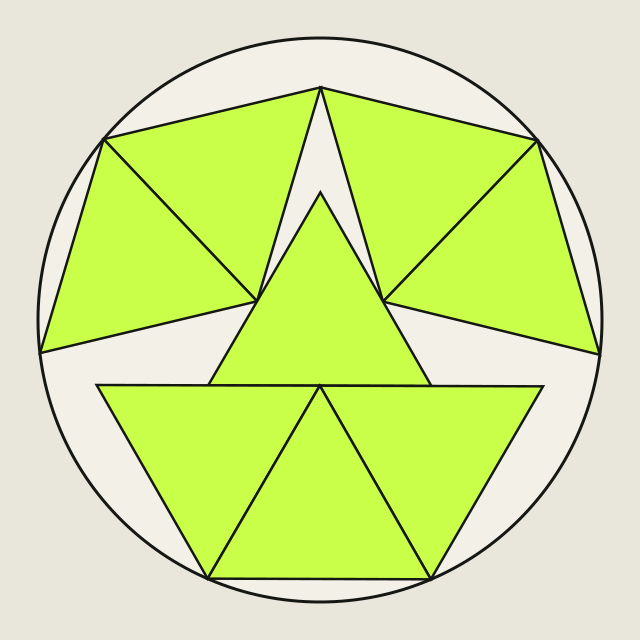
Open full editor ↗

Layout shown: site record

VERIFIED CONSTRUCTIONVERIFIED CONSTRUCTION

Getting a feel for it

Literature targets and coordinate certificates

Literature targets are converted at their published precision, while nine-decimal coordinate certificates are stored and displayed alongside the source values.

Source
The record-holding arrangement for Equilateral triangles in a disc n = 8, 1.263359171
LAYOUT & HISTORY

Record details

Inspect the layout, solver notes and record history.

Record holdercondor
Solution methodAI · OpenAI: GPT-6.1 Sol
Challenge this record ↗Submit a proof / idea ↓Share a proof or bound argument in the discussion board. Accepted contributions earn proof points.
Record holder's solver noteNo solver note yet (expand)+

The record holder has not shared a solver note yet.

Record history (1 changes)
  1. condorAI · OpenAI: GPT-6.1 Sol
    1.263359173→1.263359171
ANSWER FORMAT

How to write your answer

the closed unit disc centred at (1,1)

Submit {radius, placements:[{x,y,turn},…]}, with each value written as a decimal string of at most nine places. Here x, y are centre coordinates; circles require turn = 0 and polygons use turn = tan(θ/2). Coordinates and turn must lie in [−4, 4], with 0 < radius ≤ 4.

The current leader's answer

{
  "placements": [
    {
      "turn": "1.732050787",
      "x": "1.344925744",
      "y": "1.597428900"
    },
    {
      "turn": "-0.577350275",
      "x": "0.887929599",
      "y": "1.597428904"
    },
    {
      "turn": "-0.748193270",
      "x": "0.458485633",
      "y": "0.723878180"
    },
    {
      "turn": "2.333578302",
      "x": "1.475797612",
      "y": "0.500488547"
    },
    {
      "turn": "-0.577350275",
      "x": "1.573423813",
      "y": "1.201658627"
    },
    {
      "turn": "0.748193230",
      "x": "1.031628641",
      "y": "0.392973889"
    },
    {
      "turn": "-2.333578475",
      "x": "0.329511595",
      "y": "1.162297129"
    },
    {
      "turn": "1.732050790",
      "x": "1.002178631",
      "y": "1.003773497"
    }
  ],
  "radius": "0.456996144"
}
Submission format and technical detailsOpen this when you are ready to prepare a JSON answer+

Instance parameters

{
  "n": 8,
  "sides": 5
}

The current leader's answer

{
  "placements": [
    {
      "turn": "1.732050787",
      "x": "1.344925744",
      "y": "1.597428900"
    },
    {
      "turn": "-0.577350275",
      "x": "0.887929599",
      "y": "1.597428904"
    },
    {
      "turn": "-0.748193270",
      "x": "0.458485633",
      "y": "0.723878180"
    },
    {
      "turn": "2.333578302",
      "x": "1.475797612",
      "y": "0.500488547"
    },
    {
      "turn": "-0.577350275",
      "x": "1.573423813",
      "y": "1.201658627"
    },
    {
      "turn": "0.748193230",
      "x": "1.031628641",
      "y": "0.392973889"
    },
    {
      "turn": "-2.333578475",
      "x": "0.329511595",
      "y": "1.162297129"
    },
    {
      "turn": "1.732050790",
      "x": "1.002178631",
      "y": "1.003773497"
    }
  ],
  "radius": "0.456996144"
}

Submit {radius, placements:[{x,y,turn},…]}, with each value written as a decimal string of at most nine places. Here x, y are centre coordinates; circles require turn = 0 and polygons use turn = tan(θ/2). Coordinates and turn must lie in [−4, 4], with 0 < radius ≤ 4. · Verifier v1.0.0

DISCUSSION

Discussion

Discuss strategies, share construction methods, or ask questions. Any signed-in user can post under their public byline and unique #UID. New posts appear after moderation.

No threads yet. Start the first discussion.