P84 · Packing and covering · Classic · Hard

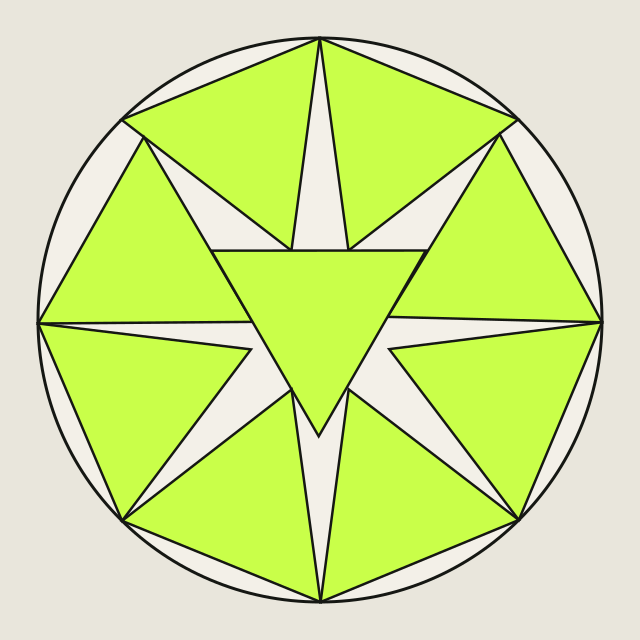
Equilateral triangles in a disc · n = 9

Pack n unit-side equilateral triangles into a disc. Contact is allowed; interiors cannot overlap. Minimise the container circle radius.

Instancen = 9
ObjectiveMinimize container circle radius
Best known, unproven1.314Source-precision interval: 1.314–1.315 (values inside match)exhibited site certificate 1.314752194Compiled by Erich Friedman; Found by David W. Cantrell in July 2002. Source expression: r = 1.314+.

Formal definition

  • ContainerThe editor and certificate normalize to the closed unit disc centred at (1,1). This is a coordinate convention only; scores use the literature's unit-piece scale. Boundary contact is allowed.
  • SubmissionSubmit {radius, placements:[{x,y,turn},…]}, with decimal strings of at most nine places. x,y are centres; circles require turn=0, polygons use turn=tan(θ/2). Coordinates and turn lie in ±4; 0 < radius ≤ 4.
  • ConstraintsExactly n congruent shapes lie wholly in the container with pairwise disjoint interiors. Polygon rotations are independent, not limited to quarter turns.
  • PrecisionInput decimals are exact rationals; regular-polygon vertices are algebraic, not rounded templates. Feasibility has no floating-point tolerance. A finite-decimal certificate is not a continuous optimality proof.
  • Objectivecontainer circle radius = 1/(2 sin(pi/3) r), smaller is better. Pages, leaderboards and literature share these units; conversion is automatic.
Open the full editor
VERIFIED CONSTRUCTIONVERIFIED CONSTRUCTION

Getting a feel for it

Source and certificate

External targets are converted with their printed precision; decimal coordinate certificates are separate. Reconstruction loss never lowers the literature target, and a source construction is not automatically an optimality proof.

Source
The record-holding arrangement for Equilateral triangles in a disc n = 9, 1.314752194
Current leader

1.314752194

container circle radius

Matches the best known
Answer sourceDavid W. Cantrell
Solution methodPublished reference construction
Challenge this record Submit a proof / idea Share a proof or idea in the discussion. Accepted contributions can earn proof points.
Record holder's solver noteNo solver note yet (expand)

The record holder has not shared a solver note yet.

ANSWER FORMAT

How to write your answer

the closed unit disc centred at (1,1)

Submit {radius, placements:[{x,y,turn},…]}, with decimal strings of at most nine places. x,y are centres; circles require turn=0, polygons use turn=tan(θ/2). Coordinates and turn lie in ±4; 0 < radius ≤ 4.

The current leader's answer

{
  "placements": [
    {
      "turn": "0.067216310",
      "x": "1.267733489",
      "y": "1.652504971"
    },
    {
      "turn": "0.492010729",
      "x": "0.731284965",
      "y": "1.652101364"
    },
    {
      "turn": "-0.281632044",
      "x": "1.625376026",
      "y": "1.221005189"
    },
    {
      "turn": "-0.263855583",
      "x": "0.378687446",
      "y": "1.210004263"
    },
    {
      "turn": "0.268352427",
      "x": "0.995071933",
      "y": "1.026596044"
    },
    {
      "turn": "0.204055598",
      "x": "0.351090320",
      "y": "0.723666532"
    },
    {
      "turn": "0.336341958",
      "x": "1.650091477",
      "y": "0.726458358"
    },
    {
      "turn": "-0.490210027",
      "x": "0.733178215",
      "y": "0.347121685"
    },
    {
      "turn": "-0.065759108",
      "x": "1.269625652",
      "y": "0.348274623"
    }
  ],
  "radius": "0.439132387"
}
Submission format and technical detailsOpen this when you are ready to prepare a JSON answer

Instance parameters

{
  "n": 9,
  "sides": 5
}

The current leader's answer

{
  "placements": [
    {
      "turn": "0.067216310",
      "x": "1.267733489",
      "y": "1.652504971"
    },
    {
      "turn": "0.492010729",
      "x": "0.731284965",
      "y": "1.652101364"
    },
    {
      "turn": "-0.281632044",
      "x": "1.625376026",
      "y": "1.221005189"
    },
    {
      "turn": "-0.263855583",
      "x": "0.378687446",
      "y": "1.210004263"
    },
    {
      "turn": "0.268352427",
      "x": "0.995071933",
      "y": "1.026596044"
    },
    {
      "turn": "0.204055598",
      "x": "0.351090320",
      "y": "0.723666532"
    },
    {
      "turn": "0.336341958",
      "x": "1.650091477",
      "y": "0.726458358"
    },
    {
      "turn": "-0.490210027",
      "x": "0.733178215",
      "y": "0.347121685"
    },
    {
      "turn": "-0.065759108",
      "x": "1.269625652",
      "y": "0.348274623"
    }
  ],
  "radius": "0.439132387"
}

Submit {radius, placements:[{x,y,turn},…]}, with decimal strings of at most nine places. x,y are centres; circles require turn=0, polygons use turn=tan(θ/2). Coordinates and turn lie in ±4; 0 < radius ≤ 4. · Verifier v1.0.0

DISCUSSION

Discussion

Talk strategy, share methods, ask why you are stuck. Every signed-in user can post. Posts carry your public byline, the same name your records use; the #number after it is the account's signup ordinal, so a name cannot be worn by someone else. New posts appear after an automated review.

No threads yet. Be the first to talk about this problem?